Disclaimer

The articles in the blog are intended for informational purposes only, with the aim of encouraging thoughtful discussions. The articles should not be relied upon as financial advice. Please read the important disclaimer at the bottom of the page before proceeding.

Mapletree Commercial Trust 4Q Earnings Briefing: What I've Learnt


I’ve always wanted to experience listening in on an earnings call with a company’s management, and to be able to observe how analysts question the company’s management on the specific operating metrics and the outlook of the company. Last week, I attended Mapletree Commercial Trust’s 4th quarter analyst briefing via webcast. I felt that it was an insightful discussion as it provided a bit more colour on the performance and the outlook of MCT’s assets, and the management had discussed further details that were not present in the earnings presentation and financial statements.

Here’s a summary of the 7 things I’ve learnt:

Source: MCT 4Q Results Presentation


1. Headline numbers were the increase in revenue and NPI by 12.6% and 12.8% respectively, from 4Q‘18. This was mainly due to the increase in contribution from the acquisition of MBC ll completed in 3Q 2019, offset by a decrease in revenue from VivoCity, due rental rebates given to tenants as a result of the Covid-19 circuit breaker measures.

2. Distribution per unit (DPU) fell by 60% to $0.91 for 4Q, due to a 42.1 mil capital allowance claim and a 1.6 mil retention of capital distribution. Management explained that the intention of claiming a capital allowance against the distributable income was to reduce the distributable income, which means that MCT would still comply with the rule that REITs must distribute 90% of their distributable income, in order to enjoy tax transparency. Management also mentioned that retaining this amount of cash was a prudent move, as cash flow is paramount during this crisis. In the event that the retained distribution is not utilised, MCT would pay out the amount as a capital distribution to unitholders, which is tax exempt.

3. Operational metrics: Portfolio committed occupancy was maintained at 98.7%. Questions were asked regarding the tenant profile of MCT, and whether certain office tenants have been affected by Covid-19, in addition to retail tenants. Management indicated that there are certain office tenants in the tourism related sector who may be affected.

There was also interest in the new Covid-19 (temporary measures) Bill passed by the government, and a question was raised regarding how many % of tenants are expected to use the Bill. Overall, management expects c.10% of tenants (by portfolio revenue) to apply to seek shelter under the Bill, mostly from the retail segment, and a small portion of the office tenants in the tourism sector as mentioned in the previous paragraph.

Regarding the number of tenants still open in VivoCity currently, management responded that around 30%, or about 100 of the 350 tenants are still in operation, but most would not be trading at normal levels.

A question was also asked regarding the percentage of tourists numbers for the Vivocity’s shopper traffic. Management replied that based on the survey done 2 years ago, tourist shopper traffic was about 20%, but would be different today.

4. Tenant relief package: MCT has given tenants a total relief package worth c.50 mil, which is equivalent to approximately 3.5 months of rental. This 50 mil package also includes miscellaneous rebates such as waivers for using the atrium space or car park rebates. Management shared that MCT is the only REIT that that gave tenants visibility on the rental relief measures up to July, hence it would not be a fair comparison to compare their current value of the rental relief package against that of other REITs, as other REITs have yet to announce their respective rental relief measures for June or July.

As a follow up on the point about rental relief, MCT indicated that the respective share of the total rental relief package worth 3.5 months of rental were 1.1 months from the government’s property tax rebates, and about 2.5 months which is MCT’s contribution.

An analyst also asked whether the security deposits from tenants were intact even with the rental rebates. Management replied that the rental rebates were in the form of waived rents, hence the security deposits are still intact.

5. Valuation issues: An analyst asked if the valuation of properties were too optimistic, given that the portfolio valuation remained flat at $8.9 billion, as there were no change in cap rates used. MCT’s NAV stood at $1.75 as of March 2020. Management’s response was that the valuations of the assets are done by independent valuers, and factors such as comparable transactions and current and future rents are taken into account. Valuers are taking the Covid-19 as a one-off thing, hence there is minimal impact on the long term valuation.

6. Capital management: MCT has refinanced all term loans due in FY ’20, with only a $160 mil MTN due in Aug 2020. Debt maturity profile is well distributed, with no more than 17% due for refinancing in any financial year. MCT has $321 mil of cash and undrawn committed facilities on hand, while. MCT’s debt headroom increased to 1.5 billion, after MAS increased the gearing limit for REITs to 50%. MCT’s relatively low gearing ratio of 33.3% means that it has the ability to increase its debt if required.

7. Outlook: With regard to rental renewals, management noted that 18.8% of leases are up for renewal in this FY, with 8.1% and 10.7% coming from the retail and office segments respectively.

Overall, I felt that dialing in to the earnings call by the management was very insightful. It provided me with a better understanding of the key metrics that equity research analysts were looking out for, and I would definitely be attending more earnings calls in the future.

For the full transcript, I have included the link below:


If you're keen to learn more about REITs, I have written two posts here:

Note: As of time of writing, I have divested my position in MCT.

Disclaimer: This article is intended for informational and discussion purposes only, and do not constitute financial advice. When in doubt, please contact a licensed financial adviser.


If you enjoy my articles, please 'Like' my Facebook Page at: 
https://www.facebook.com/AlpacaInvestments/


Follow me on Instagram at @AlpacaInvestments

Portfolio Updates - Staying the Course


Markets rallied strongly over this short trading week, with US indices entering a bull market, which is defined as a >20% gain from the bottom. Optimism over the potential flattening of the curve in US and Europe, along with further stimulus from the Fed helped markets recover from their lows 2 weeks ago. Overall, my portfolio is down about 10% based on cost. Here’s my updated portfolio as of 9 April 2020:


DBS – The bank has been aggressively buying back shares since January, spending in excess of $400 million, which is greater than the full year amount spent in the past 4 years. DBS’ AGM has been postponed, which means the final dividend would be delayed. There is a concern that as Stanchart and HSBC have scrapped dividends due to the uncertainty ahead, DBS would follow suit as well. While Stanchart and HSBC were told by UK Regulators to scrap their dividends, DBS has not faced a similar advisory from MAS. MAS has indicated that “sustaining lending activities should take priority” and that the “release of capital buffers should not be used to finance share buybacks during this period”. However, given the amount of money that had been spent on aggressive share buybacks, and a cut in dividends would not bode well with investors. This was a question I wanted to raise at the AGM, but that would not be possible for now.

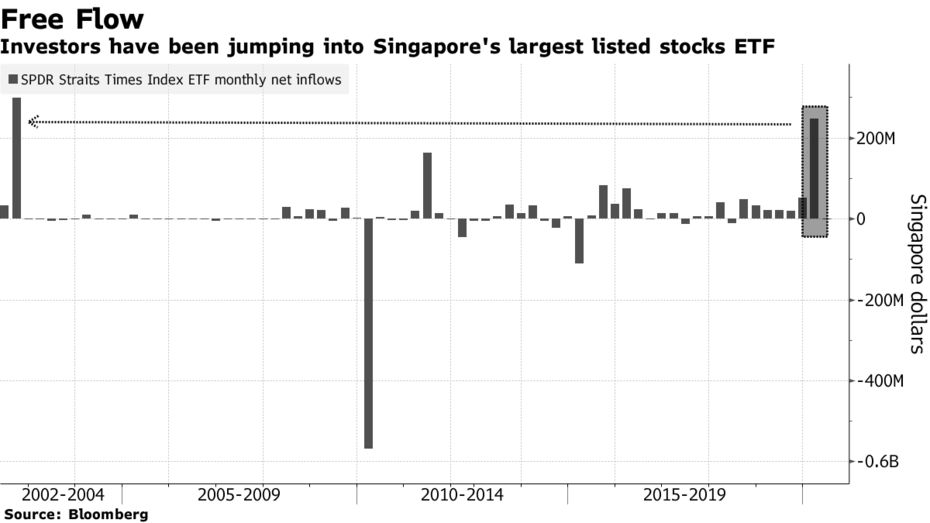
SGX – With the recent market volatility, trading volumes have shot through the roof which benefits SGX. Securities daily average value (SDAV) for March more than doubled year on year to $2.19 billion, while ETF turnover increased eight fold to $1.2 billion for March. Interestingly, investors have been pouring money into ETFs, with the inflows for the STI ETF as the highest level since 2002 (refer to chart below). Structured warrants and DLC value traded also rose by 76% year on year. With more volatility expected ahead, SGX stands well positioned to benefit from the increased trading activity – which is great – whether investors gain or lose, SGX still makes money!

Source: Bloomberg


SATS – Further support measures for the aviation sector provided some relief for SATS’ share price, which had been battered down by the Covid-19 crisis. Aviation remains a strategically important sector for Singapore, hence there are vested interests to ensure that SATS is able to weather this unprecedented challenge. Recently, SATS also managed to borrow $200 million due 2025 at 2.88%, a relatively favourable rate which indicates the market’s confidence in SATS’ financial strength. Interestingly, SATS bought back shares at around the $2.81 to $3.04 range immediately after raising debt on 31 March, which may indicate the management’s view that the company’s shares are undervalued. Between 1 to 7 April, SATS purchased a cumulative total of 535,000 shares.

I have written more about SATS here:

Mapletree Commercial Trust – This is a REIT that I’ve been following for a long time, hence I entered at $1.61 which I feel is a reasonable price. MCT’s revenue exposure to VivoCity is around 45%, which would be severely impacted by the circuit breaker measures. However, the rest of MCT’s assets are office properties, which would be less affected, apart from commercial tenants that have to wind up due to the downturn. In the long term, I believe that the development of the Greater Southern Waterfront precinct would benefit MCT, hence I would be ready to increase my position if the opportunity arises.

If you're keen to learn more about REITs, I have written two posts here:

ETFs – Averaged down on STI ETF at $2.49 and entered a new position for 2800.HK at 24.05 HKD, which tracks the Hang Seng Index. To me, ETFs are positions that I intend to hold forever, so volatility does not matter to me. In fact, because I don’t intend to cash out on my positions, I treat them as more like ‘bonds’ and simply collect a 4 to 5% yield into perpetuity, which is decent enough for me. I have wrote some brief thoughts on the valuations of the various HSI sub-segments here:

My foray into ETFs is primarily driven by two reasons. First, we only can evaluate if we have outperformed the market based on hindsight. Let’s say 20 years from now, we realise that we are not as great of an investor as we perceived, and have underperformed the market. By then, it would be too late to realise that you would have been better off with a passive investment portfolio. Therefore, having a proportion of my portfolio in diversified ETFs serves as an ‘insurance’, to ensure a part of my portfolio gets the market return in the long run. The second reason is more practical – if I were to work in the finance sector in the future, it is likely that trading restrictions would be placed on individual stocks, whereas ETFs would still be allowed. Hence, it would be good for me to get some ETF exposure early.

I am looking to diversify my ETF holdings to track 3 main indices – STI, HSI and the S&P500.

Watchlist

I’m looking at US financials/tech, and maybe 1 or 2 Singapore REITs to add to my portfolio. Would probably be funded by cash and proceeds from a potential divestment of Singtel, Jumbo or Hanwell.

Thoughts on the current market

Honestly, your guess is as good as mine with regard to the Covid-19 situation. While the current slump started off as a healthcare crisis, it quickly resulted in a financial crisis as businesses remain shut and trade slowed. Globally, we would probably see the lockdown measures extend for at least another month or two. And experts have warned about the risk of infections rising again if the social distancing measures are relaxed. Personally, I believe that the US mortgage market is at risk, given that it was reported that one third of tenants failed to pay their rent in March. As unemployment soars in the US, more people are unable to pay their rent, which in turn results in mortgage backed securities at risk. While the Fed has shown their ability to intervene in the mortgage market, there is only so much they can do.

Nonetheless, for equities, I am constantly on the lookout for bargains. While for ETFs, I am more comfortably with a dollar cost average strategy as I take a long term view. I would continue to consolidate my portfolio by trimming underperforming positions and averaging down on high conviction bets, while initiating new positions in companies that I find attractive. Overall, I want my portfolio to emerge from this crisis stronger.

Disclaimer: This article is intended for informational and discussion purposes only, and do not constitute financial advice. When in doubt, please contact a licensed financial adviser.

If you enjoy my articles, please 'Like' my Facebook Page at: https://www.facebook.com/AlpacaInvestments/

Follow me on Instagram at @AlpacaInvestments