Disclaimer

The articles in the blog are intended for informational purposes only, with the aim of encouraging thoughtful discussions. The articles should not be relied upon as financial advice. Please read the important disclaimer at the bottom of the page before proceeding.

Thoughts on SATS' 1Q results (SGX:S58)


SATS released their 1Q FY2021 business updates on 24 August, which was for the period of 1 April 2020 to 30 June 2020. Headline numbers were a 55% fall in revenue to $209.4m, and a net loss of $43.7m. Aviation revenue decreased 72.9% to 110.6m while non aviation revenue rose by 73.3% to 96.9m.

Despite the challenging operating environment, I believe that the long term outlook for the aviation industry is still positive. In short, as the middle class gets wealthier, demand for air travel should increase as well. I believe that this is a long term secular trend that has only been temporarily disrupted by Covid. While Covid has probably resulted in many executives re-thinking the necessity for business travel, I believe that leisure travel would still recover strongly due to all the pent up demand. Even if business travel were to never recover to pre-Covid levels, I believe that growth in leisure travel would more than offset the fall in business travel. Furthermore, falling business travel volumes would hurt airlines more, as compared to a ground handler like SATS, because airlines earn a significant proportion of their revenue from business class passengers, whereas I believe that the differential in revenue to SATS from a business class traveler and an economy class passenger is much lower. 

Current projections are that the aviation volume would only return to pre-Covid levels by 2024. Hence, I think the key question that we should be asking ourselves as investors or potential investors would be - at the current level of losses, can the company's cash burn rate be sustainable until 2024?

The answer to this question is by no means straightforward. In addition to economic factors, there are regulatory and policy decisions, as well as the likelihood of an effective vaccine, that would affect our projections. But looking at SATS' cost structure and cash burn rate would be a good start.

Cost structure 

Staff costs make up the largest proportion of operating costs for SATS, at 39% for this quarter. This compares with 57% in ordinary times. One reason for the reduced staff costs was the $61.7m of government reliefs received from the Jobs Support Scheme (JSS). The JSS was extended in August to cover wages up to March 2021, but the co-funding was reduced to 50% of wages (capped at gross wage of $4,600) instead of 75% previously for the aviation industry. 

Depreciation costs are mostly non-cash in nature, however, with the change in accounting standards due to IFRS 16, right-of-use assets are depreciated as well, hence a portion of the depreciation costs actually represent an outflow of cash for the current year.  

Operating cash flow was -$61.1m for the quarter. Comparing this to PATMI of -43.7m, and accounting for depreciation of $33.5m (largely non-cash expense apart from IFRS 16 changes), I believe that the difference may be due to the timing of receiving the JSS grants of $61.7m. For example, the JSS payout computed based on wages in June to August 2020 would only be paid out in October 2020. Capex came in at $10.4m, comparable to Q1 FY20 which was also $10.4m. Hence, we are looking at a free cash flow of around -30m to -40m for this quarter if the cash received from the JSS payouts were adjusted for.

Cash position

SATS currently has a cash position of $723.5m, an increase which is mainly due to the increased borrowings. Debt to equity ratio of 42% (55% if IFRS 16 was considered) as compared to 26% the previous quarter seems moderately high to me, but the total debt of $876.1m as compared to the cash position of $723.5m puts things into perspective. 

Assuming SATS continues a cash burn of around 30m to 40m per quarter (this assumption largely hinges on JSS payouts), then it seems possible that the company would be able to ride out the storm, given that hopefully, the worst quarter is behind us, and aviation volume gradually increases.

Closing thoughts

The aviation industry's troubles are unlikely to go away soon. Airlines are still in trouble. SIA reported that within 2 months, it has burnt through half of the $8.8 billion raised through their rights issue in June. 

Budget carriers may be at greater risk as compared to national flag carriers, due to the lack of state support - governments have vested interest to bail out their national flag carriers as opposed to budget carriers. Would this bode well for SATS when demand returns? Possibly, given that budget carriers, without the inflight meals, SATS earns less per passenger.

For me, I would prefer to bet on SATS for a recovery in aviation, rather than on airlines, mainly due to the differences in cost structure and cash burn rate.


Note: As of writing, hold a long position in SATS at an average price of $3.41. 

Disclaimer: This article is intended for informational and discussion purposes only, and do not constitute financial advice. When in doubt, please contact a licensed financial adviser.


If you enjoy my articles, please 'Like' my Facebook Page at: 

Follow me on Instagram at @AlpacaInvestments 

Is There Value in Valuetronics? (SGX: BN2)


The last time I wrote about Valuetronics was in late 2019, when I published this article (Valuetronics Research). I had done some research on the company as part of my internship application to an asset management firm. Subsequently, Valuetronics’ share price climbed to a high of $0.86, before falling to a low of $0.435 during the selloff in March.

After a strong recovery, Valuetronics’ share price tumbled again this week, as the management guided for a poor outlook in the near future, due to the renewed US-China trade tensions, which causes Valuetronics’ exports to the US to be subjected to tariffs ranging from 7.5% to 25%. Consequently, management indicated that some customers in the auto and consumer electronics segment were considering a switch of suppliers, and warned of “significantly lower financial results in FY2021”.

Company Overview


Source: Valuetronics FY20 Presentation


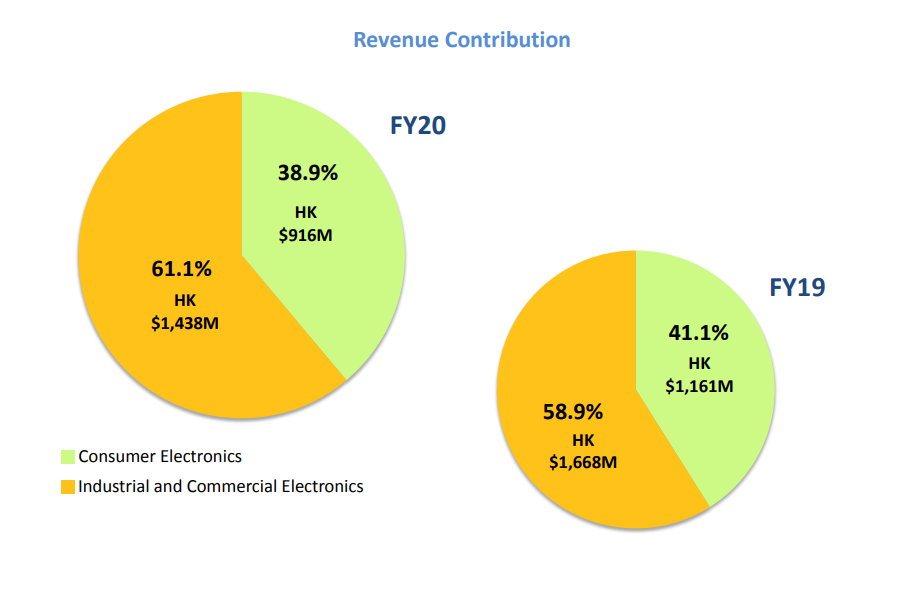
Valuetronics is an electronics manufacturer headquartered in Hong Kong. The company provides integrated manufacturing, design, and development services. It operates in two segments, the Consumer Electronics segment, and the Industrial & Commercial Electronics segment. The CE segment accounts for 39% of revenue, and 61% of revenue is derived from the ICE segment. The company’s products include smart lighting, printers, automotive and communications products.

FY2020 Earnings Review

Trade tensions have adversely impacted Valuetronics’ FY2020 results, as revenue declined by 16.8% from 2.83 bil HKD to 2.35 bil HKD, while gross profit margin expanded slightly from 15.2% to 15.4%. Net profit fell from 199.5 mil to 178.9 mil HKD, a decline of 10.3%, while net profit margin increased from 7.1% to 7.6%.

The positives

Source: Valuetronics FY20 Presentation


Continued diversification out of China, with further expansion in Vietnam ongoing. US-China trade tensions had an adverse impact on Valuetronics, given that c.41% of the company’s revenue is derived from US shipments.

Valuetronics has been working to mitigate the adverse impact of tariffs by building up its production facilities in Vietnam. Mass production at its Hanoi plant began in June 2019, while trial production at a second facility started in May 2020. The company also acquired a plot of land in an industrial park in Vietnam to build a manufacturing campus, which is projected to commence mass production by 31 March 2022. This would further boost production capacity, and diversification of its production base beyond China.

Robust balance sheet with a net cash position, reducing downside risks. Valuetronics’ net cash per share stands at 44 cents, with a NAV of 50 cents. This compares with the closing price of 59.5 cents on Friday. With its net cash position making up c.66% of its market capitalisation, downside risks would be mitigated. However, it would be good to note that 200 mil HKD is earmarked for the capex for their new facility in Vietnam.

The negatives

Escalation of US-China Trade War – Currently, c.41% of Valuetronics’ revenue is derived from shipments to the US, which are subjected to tariffs ranging from 7.5% to 25%. Further escalation in trade tensions may pressure more customers to seek alternative suppliers.

Potential Upside?

Positive developments from the US-China trade negotiations – Perhaps if Trump fails to get re-elected, this may be a positive for Valuetronics if trade tensions are resolved?

Valuation – Discounted Cash Flow

I didn’t want to go into the details of how the FCFF figures were projected, because that would involve many detailed assumptions of revenue drivers, expenses, margins etc. Thus, a high level view of estimating the future FCFF would suffice instead.


The following assumptions were used for the Discounted Cash Flow valuation of the company.

1. Drop in FCFF for FY21 and FY22 due to falling revenue as more North American customers switch suppliers, followed by a recovery in FY23 due to the opening of the Vietnam campus in end FY22.

2. Discount rate of 10% to reflect the small cap premium as well as uncertainty around longer term earnings. 0% terminal growth rate was used as a conservative estimate.

3. FCFF of c.10 – 85m for the projected years, which is significantly lower than the average of c.180m for the past 6 years. FCFF for the past 6 years were fluctuating mainly due to the changes in working capital. If we looked at cash flows before changes in working capital instead, we get a relatively consistent number of 200 – 250 mil, with income tax paid of 10 to 20m annually.

4. Annual capex of 120m HKD for the terminal value, with FY21 and FY22 at 150m to reflect the higher capex commitments of c.200m HKD for the new Vietnam facility.

5. Cash of 800 mil HKD was used in the calculation of equity value, to account for the 200 mil HKD earmarked for the capex in Vietnam.

With the above assumptions, a DCF derived price of $0.66 was obtained.

Why P/E may not be meaningful

I think that while a P/E ratio is easy for investors to understand, it may not be an appropriate metric to evaluate a contract manufacturer like Valuetronics. Bear in mind that the following thoughts are coming from a business student with zero knowledge of the manufacturing industry, so please take them with a huge pinch of salt. For those with more in-depth knowledge on the relationships between suppliers and customers in the manufacturing industry, please let me know in the comments.

While I mentioned P/E as a valuation metric in my previous article, I am currently of the view that P/E would not be a good valuation metric, mainly because of the nature of the manufacturing industry. A P/E valuation would be more reliable for companies with stable and predictable earnings – for example, consumer stocks like Sheng Siong. However, while Valuetronics’ earnings have been relatively stable over the past few years, the certainty of earnings is questionable, because once a manufacturing contract expires, the customer may switch over to another supplier if the costs are lower. As we are witnessing currently, the certain customers have indicated that they may switch suppliers due to the tariffs imposed on the shipments from China. For Valuetronics, if earnings were to drop in a given year, using a P/E multiple on that year’s earnings would give a significantly lower valuation.

Hence, to compare Valuetronics’ P/E ratio to a bunch of peers like Venture Corp, AEM or UMS may not provide the best estimate of its valuation, because of the each of these companies are vastly different. Venture’s market cap is significantly larger than Valuetronics, thus Venture may have greater bargaining power or economies of scale for production. For a smaller manufacturing company, I believe that the firm would more likely be a price taker, with less bargaining power when negotiating with larger customers. Whereas AEM and UMS have extremely concentrated customers, which itself brings about an entirely different set of benefits and risks.  

Conclusion

Source: Valuetronics FY20 Presentation


I like the company as it has been operating very conservatively by building up a huge cash buffer over the years. Before the Covid-19 crisis, I have questioned the need for the company to build up such a huge cash reserve, but I think the Covid-19 crisis has shown us the importance of companies having a strong balance sheet. Valuetronics business has also been incredible at generating positive free cash flows, which is what I look out for in any business. As shown above, Valuetronics has managed to increase its cash holdings from 689 mil to 1 bil HKD over the past 5 years through its strong cash flows. This gives them the ability to fund expansion plans without taking on any debt.

While earnings would be impacted in the short term, I believe that any downside would be well supported by its net cash per share of c.44 cents, while a successful diversification of its production facilities to Vietnam would be beneficial to investors in the longer term.


Note: As of writing, I don't not hold a position on Valuetronics. 

Disclaimer: This article is intended for informational and discussion purposes only, and do not constitute financial advice. When in doubt, please contact a licensed financial adviser.

If you enjoy my articles, please 'Like' my Facebook Page at: 

Follow me on Instagram at @AlpacaInvestments